


 English
 中文简体
中文简体 русский
Industry news
 Home / News / Industry news / Why Won't PVC Glue Work on HDPE Pipe? The Proper Way to Use HDPE Socket Fusion Fitting for Transitions
 Why Won't PVC Glue Work on HDPE Pipe? The Proper Way to Use HDPE Socket Fusion Fitting for Transitions
 2026.02.09
 Industry news
Technical Analysis: Compatibility Between PVC Fittings and HDPE Piping
In piping engineering, using PVC solvent-cement fittings directly on HDPE pipe is strictly prohibited. This is due to fundamental chemical incompatibility and significant differences in physical properties.
Material Differences and Connection Challenges
Chemical Bonding Failure: PVC (Polyvinyl Chloride) is a polar polymer that can be dissolved by solvent cements to create a chemical bond. HDPE (High-Density Polyethylene) is a non-polar, chemically inert material. No standard solvent cement can dissolve the surface of HDPE to create a bond with PVC.
Physical Property Mismatch: The two materials behave differently under thermal and mechanical stress:
| Performance Metric | PVC (Polyvinyl Chloride) | HDPE (High-Density Polyethylene) |
| Thermal Expansion Coeff. | Approx. 50 x 10^-6 /K | Approx. 150-200 x 10^-6 /K |
| Impact Resistance | Lower (Brittle at low temps) | Extremely High (Ductile to -40°C) |
| Connection Method | Solvent Welding / Gasket | HDPE Socket Fusion Fitting |
| Max Temp Limit | Approx. 60°C | 60°C Continuous / 80°C+ Short-term |
Key Technical Note: Because the expansion rate of HDPE is 3 to 4 times higher than that of PVC, any rigid mechanical connection between them will likely fail or leak during temperature fluctuations due to differential contraction.
Advantages of HDPE Socket Fusion Fitting
For small-diameter HDPE piping systems (typically up to 110mm), the HDPE Socket Fusion Fitting is the industry standard for ensuring system integrity.
Molecular Fusion: Unlike PVC fittings that rely on glue to fill gaps, the HDPE Socket Fusion Fitting process involves heating both the internal surface of the fitting and the external surface of the pipe. When joined, the polymer chains intermingle, creating a homogenous joint without a physical seam.
Structural Strength: Once cooled, the joint area is thicker than the pipe wall, meaning the HDPE Socket Fusion Fitting connection is usually stronger than the pipe itself.
Standard Fusion Parameters: Typical requirements for installing an HDPE Socket Fusion Fitting at an ambient temperature of 20°C:
| Pipe Diameter (mm) | Heater Temperature (°C) | Heating Time (sec) | Changeover (sec) | Cooling Time (min) |
| 20 | 260 ± 10 | 5 | 4 | 2 |
| 32 | 260 ± 10 | 8 | 6 | 4 |
| 63 | 260 ± 10 | 24 | 8 | 6 |
| 110 | 260 ± 10 | 50 | 10 | 10 |
Transition Solutions Between PVC and HDPE
When a project requires connecting these two different materials, a direct sleeve fit is impossible. Transition must be achieved through:
Flange Transition Method:
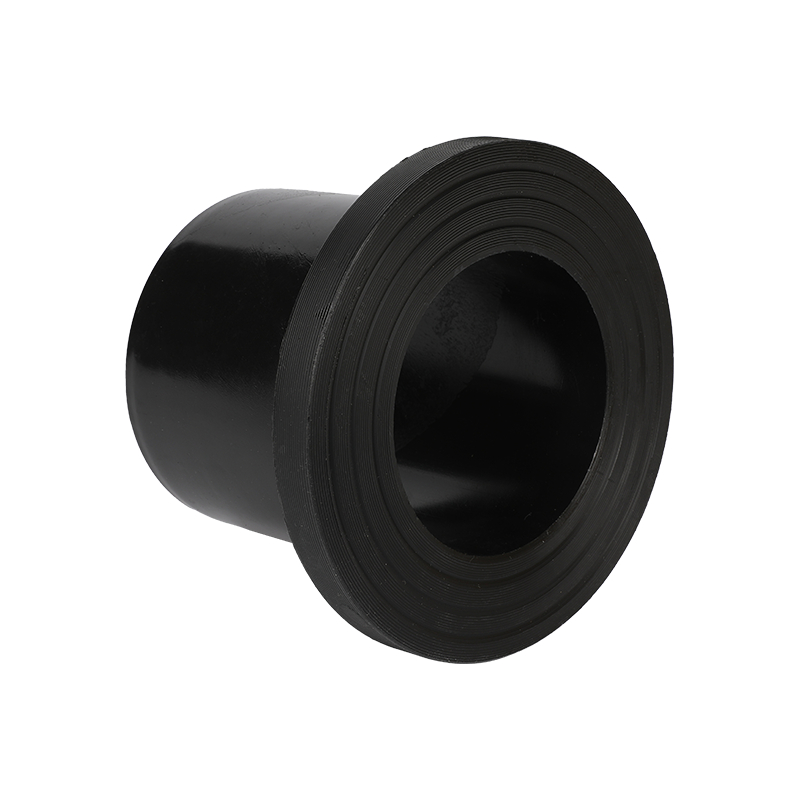
On the HDPE Side, weld an HDPE Socket Fusion Fitting flange adapter (stub end) to the pipe. On the PVC Side, use a PVC solvent-weld flange adapter. Join the two using a rubber gasket and galvanized or stainless steel backing rings secured with bolts.
Threaded Transition:
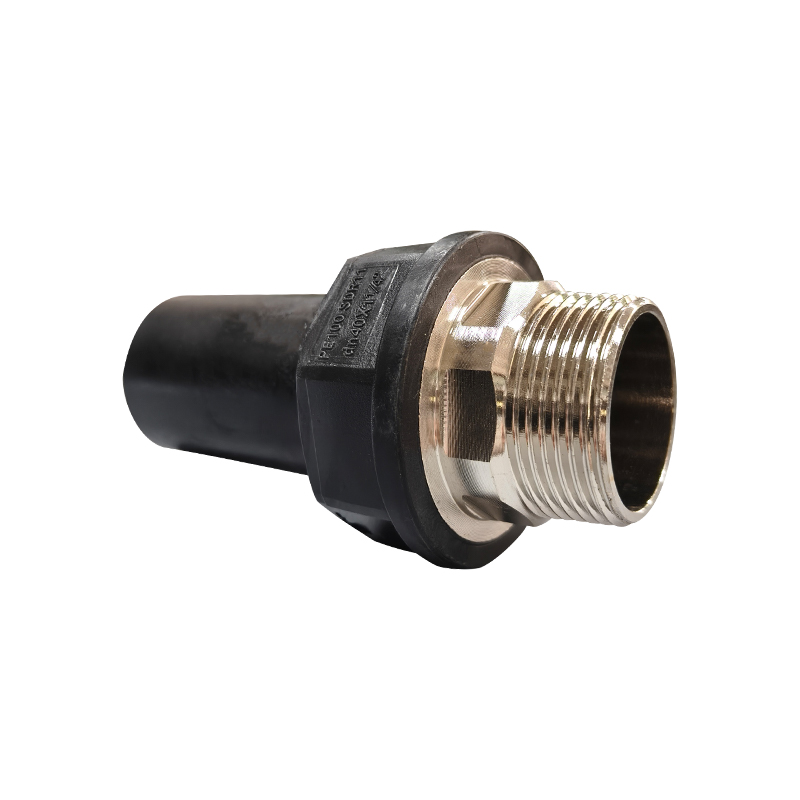
Utilize a specialized HDPE Socket Fusion Fitting that features a transition to standard pipe threads (NPT or BSP). It is recommended to use the HDPE side as the male thread and the PVC side as the female thread to prevent thread stripping caused by thermal expansion.
FAQ
Can I use PVC cement to bond HDPE into a PVC elbow?
No. HDPE has a low surface energy, meaning it acts like a non-stick surface. PVC glue will simply peel off the HDPE pipe once it dries, leading to immediate failure under pressure.
When should I choose an HDPE Socket Fusion Fitting over Butt Fusion?
Socket fusion is preferred for diameters 110mm and smaller, especially in tight spaces or complex manifolds where precise alignment is easier to manage with socket-style joints.
What happens if I don't scrape the pipe before using an HDPE Socket Fusion Fitting?
HDPE develops an oxidation layer when exposed to air. If this layer isn't removed with a scraper, it acts as a barrier, preventing the molecular fusion between the pipe and the HDPE Socket Fusion Fitting, resulting in a cold joint that will leak.
Are PVC fittings stronger than HDPE fittings?
While PVC has higher tensile strength at room temperature, HDPE Socket Fusion Fitting connections are superior in terms of fatigue resistance, surge pressure absorption, and performance in freezing environments.
KEEP IN TOUCH

About Us
Zhejiang Fengfeng Pipe Industry Co., Ltd. uses efficient single screw injection molding machines for high productivity and low energy use.
Products link
Contact
-

+86-19858193396
+86-13735359894 -

+86-0574-63555288
-

-

No. 21, Market Road, Diankou Town, Zhuji City, Shaoxing City, Zhejiang Province, China