


 English
 中文简体
 русский
Industry news
 Home / News / Industry news / How long do HDPE pipe fittings last: Practical Applications, Selection, Performance, and
How long do HDPE pipe fittings last: Practical Applications, Selection, Performance, and
 2026.10.26
 Industry news
HDPE Pipe Fittings: 50 Years Is a Design Basis, Not an Expiry Date
HDPE pipe fittings can last 50 years or more in most water, gas, and industrial systems, and 100-year service is realistic when the compound, wall thickness, and fusion procedure are correctly matched. In pipe fitting manufacturing, that outcome is not determined by the pipe alone. The fitting's socket, spigot, and fusion zone must be molded from a PE compound with a verified minimum required strength, and the field joint must be made without contamination, moisture, or temperature drift.
For a manufacturer, lifetime claims start with ISO 9080 regression testing. The "50 years" is derived from extrapolating hydrostatic strength data at 20°C. It is a design basis, not a failure countdown. Many excavated PE pipelines installed in the 1970s still test above their original pressure rating. Fittings molded from the same PE100 family behave the same way, provided the injection molding process does not introduce stress concentrations or degraded material.
What Actually Determines the Life of an HDPE Fitting?
Fitting service life can be grouped into three controllable areas: material grade, molding quality, and joint integrity. A failure in any one of them can reduce a 100-year system to a 10-year repair cycle.
Material Grade
PE80 and PE100 are the two common families. PE100 has a higher minimum required strength at 20°C and better resistance to slow crack growth. For buried pressure systems, PE100 is the most common recommendation for a 50-year design life.
Molding Quality
Injection-molded fittings depend on uniform cooling and controlled weld lines. A low-quality mold or excessive regrind can create microvoids and internal stress, which change crack initiation time.
Joint Integrity
Butt fusion, electrofusion, and socket fusion all require proper surface preparation, heating time, and cooling time. The joint is the most likely location for premature failure, not the fitting wall.
Connection Methods and Fitting Life: Butt Fusion, Electrofusion, and Socket Fusion
The joint is the highest-risk zone. The following molded fittings are designed to keep that zone as strong as the pipe wall.
Butt Fusion Fittings
Butt fusion creates a continuous weld by heating pipe ends against a mirror plate and pressing them together. Properly made butt fusion joints have a tensile strength equal to or higher than the parent pipe. For large-diameter water mains and industrial lines, this is the dominant method. A typical pressure-rated equal tee in the butt fusion series is made from PE100 and has a fusion face that meets the geometry requirements of DVS 2207 or ISO 21307.
 HDPE Butt Fusion Equal Tee for Large-Diameter MainsThis equal tee is part of the butt fusion series, ideal for water mains and industrial lines where continuous welds match or exceed pipe strength.View Product →
Electrofusion Fittings
Electrofusion fittings contain an embedded resistance wire that melts the surrounding polymer. This method is widely used for repairs, tie-ins, and medium-diameter branches where space is limited. The service life of an electrofusion joint depends on the heating time, ambient temperature, and complete cooling before pressure is applied. A coupler with clean socket surfaces and an unexpired coil is capable of maintaining the same pressure class as the pipe.
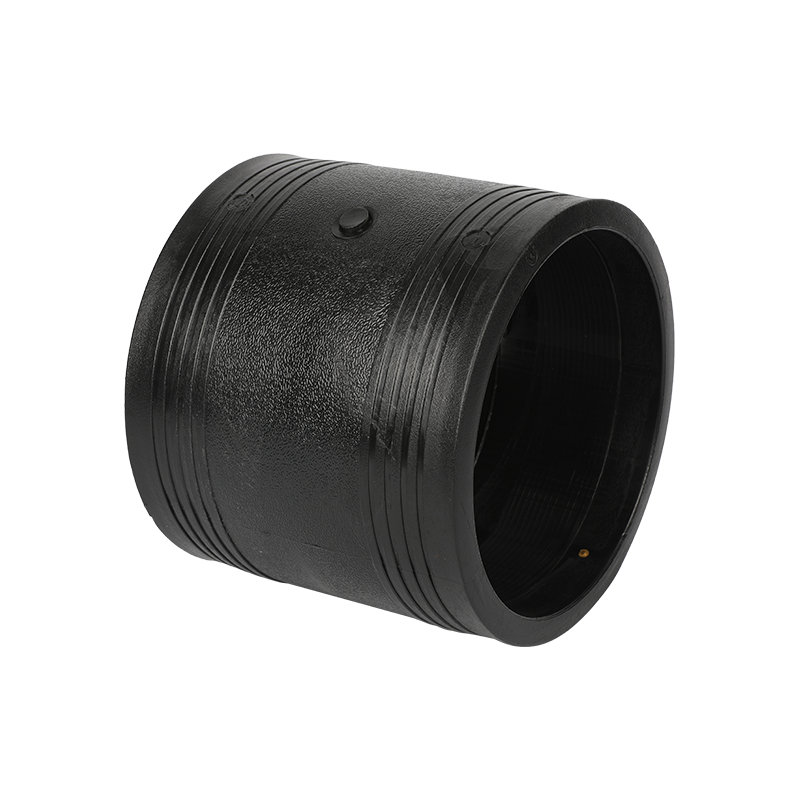 HDPE Electrofusion Equal Coupler with Embedded CoilThis coupler suits repairs and tie-ins in tight spaces, using resistance wire melting to maintain the same pressure class as the pipe.View Product →
Socket Fusion Fittings
Socket fusion is common for small-diameter pipes up to 110 mm. The fitting is heated on a socket heater for a specified time, then pushed onto the pipe end. This method is fast and economical, but socket depth and heating time are critical. If the fitting is overheated or fully inserted after a long delay, the weld zone can become brittle. When socket depth is controlled within the template tolerance, the joint retains the full pressure rating.
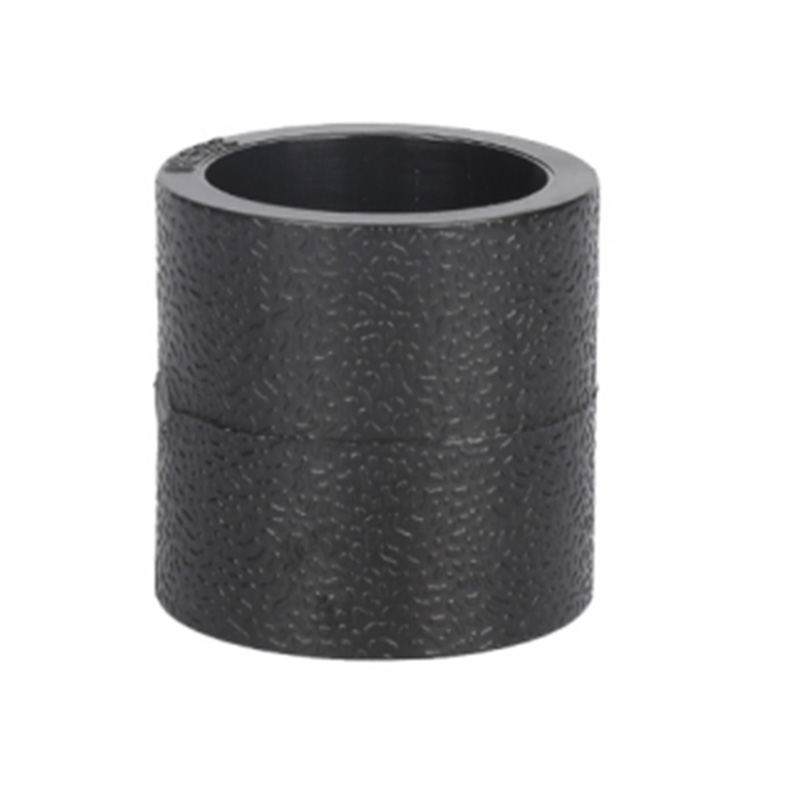 HDPE Socket Fusion Equal Coupler for Small PipesFor pipes up to 110 mm, this coupler offers fast, economical joints when socket depth and heating time are carefully controlled.View Product →
Regardless of connection type, the fusion zone must be cooled naturally. No water spray, compressed air, or forced load should be applied during joint cooling. A leak-proof HDPE connection checklist should be reviewed before every crew starts welding.
Pressure Rating, Temperature, and Chemical Exposure: How They Change Lifespan
A 50-year life is always quoted at 20°C for water under steady pressure. Real systems often operate at different temperatures, with cyclic loads or aggressive fluids. The system designer must adjust pressure rating, wall class, or both. The table below summarizes common conditions.
| Condition | Effect on Fitting Life | Practical Guidance |
|---|---|---|
| SDR 11 / PN16 at 20°C | 50-year design life | Standard for buried water and gas |
| SDR 17 / PN10 at 20°C | 50-year life at lower pressure | Use where pressure is moderate |
| Cyclic pressure | Fatigue can start at stress concentrations | Choose SDR 11 or thicker for repeated surges |
| Sustained 40°C water | Allowable pressure derated by roughly 60% | Reduce pressure or increase SDR thickness |
| Chemical oxidants | Can accelerate slow crack growth | Confirm chemical compatibility before use |
These numbers are not an exact guarantee for every installation. They illustrate why the same fitting can last 100 years in one plant and only 15 years in another if pressure surges or temperature are not considered.
Field Evidence: What Dig-Up Studies Show
Excavated HDPE pipe and fittings from early municipal installations provide the most convincing data. In several studies, polyethylene pipes removed after 30 to 50 years of service retained more than 90% of their original tensile strength. Fittings from the same period, when removed and tested, showed no wall degradation beyond the expected oxidation layer of less than 0.5 mm.
The graph below shows the range of service life under different control levels:
PE100, correct fusion, clean water
PE100, correct fusion, cyclic pressure
PE80, moderate installation quality
Poor fusion or overloaded joint
The important point is that fitting life is not a product attribute alone. It is a system attribute that includes the fitting, the joint, and the operating history.
Installation and Maintenance Mistakes That Shorten Fitting Life
Most premature failures in HDPE systems are traced to installation errors rather than material degradation. The following checklist addresses the most common issues we observe in our support work with contractors and distributors.
- Heating the pipe and fitting in sand, dirt, or rain introduces contamination that weakens the fusion interface.
- Using a socket heater at the wrong temperature creates either incomplete melting or thermal degradation.
- Pulling the joint into alignment during cooling creates residual tensile stress.
- Applying pressure before full cooling allows the weld zone to pull apart.
- Storing fittings near solvents, fuel oil, or strong oxidizers can start surface crazing.
- Using metal reamers or blades that gouge the pipe surface leaves stress concentration points.
A simple rule: if you would not hold the fusion face with your bare hand during the process, the parts are not clean enough. Following the manufacturer's joining procedure is the most reliable way to keep a 50-year rating valid.
How to Confirm the Fitting Will Meet the Expected Life
Buyers can reduce long-term risk by verifying four details before acceptance: the PE grade marked on the fitting, the SDR or pressure class, the applicable standard, and the production date. A fitting with an unclear material traceability mark creates an unverifiable service life.
At the manufacturing level, a reliable way to judge molding quality is to inspect the gate area and flash lines. A molded fitting should have uniform color, no burn marks, and no visible sink marks on thick sections. If possible, request hydrostatic test certificates or short-term pressure test records from the same production lot.
For large projects, working with a factory that controls the full process from resin selection to final pressure testing is a practical advantage. Our production facility uses the same PE100 grades for butt fusion, electrofusion, and socket fusion ranges, so the entire network ages at a consistent rate.
Frequently Asked Questions
Do HDPE pipe fittings last shorter than HDPE pipe?
No. Fittings made from the same PE grade and rated for the same pressure class have the same design basis as the pipe. The joint is the part that can fail earlier, so the joining procedure matters more than the fitting itself.
What does the 50-year rating actually mean?
It means the material has a minimum required strength that, when extrapolated via ISO 9080 methods, supports a continuous internal pressure for 50 years at 20°C without failure. It is not a guarantee of replacement after 50 years; many systems last much longer.
Can an electrofusion fitting be reused?
No. Once the resistance wire has been heated and the polymer has melted, the electrical coil and the socket surface are consumed. Reusing an electrofusion fitting is unsafe and invalidates the pressure rating.
Does UV exposure reduce the life of HDPE fittings?
Prolonged exposure to intense sunlight will blacken or chalk the surface, but carbon black-stabilized HDPE retains most of its mechanical strength. In above-ground installations, protect fittings from direct UV for the intended service life.
What is the difference between PE80 and PE100 regarding fitting life?
PE100 has a higher minimum required strength, which allows a thinner wall for the same pressure or a higher pressure for the same wall. PE100 also shows better slow crack growth resistance, making it the preferred choice for a 50-year design life.
Can I use the same fitting for drinking water and wastewater?
For most municipal applications, yes. PE100 fittings can be used for both, as long as the pressure class matches and the fitting complies with the relevant potable water approvals.
KEEP IN TOUCH

About Us
Zhejiang Fengfeng Pipe Industry Co., Ltd. uses efficient single screw injection molding machines for high productivity and low energy use.
Products link
Contact
-

+86-19858193396
+86-13735359894 -

+86-0574-63555288
-

-

No. 21, Market Road, Diankou Town, Zhuji City, Shaoxing City, Zhejiang Province, China