


 English
 中文简体
 русский
Industry news
 Home / News / Industry news / What Is a Mechanical Coupling for HDPE Pipe? Types, Selection & Installation
What Is a Mechanical Coupling for HDPE Pipe? Types, Selection & Installation
 2026.10.19
 Industry news
What Is a Mechanical Coupling for HDPE Pipe?
A maintenance crew arrives at a buried HDPE water line that is leaking in a wet trench. There is no electrofusion machine, no generator, and not enough space to move a heavy butt fusion rig. Within an hour, the crew cuts out the damaged section, slides on a mechanical coupling, tightens the bolts, and pressure-tests the joint. That is the main job of a mechanical coupling for HDPE pipe.
The short answer is this: a mechanical coupling for HDPE pipe is a non-fusion connecting device that joins two pipe ends by clamping around the outside of the pipe. It uses an elastomeric seal, a rigid housing, and a mechanical tightening element such as a bolted ring, threaded nut, or compression segment. The HDPE pipe surface is not melted, and no electrical power is needed for welding.
A mechanical coupling does not create a monolithic pipe wall. Instead, it creates a sealed mechanical joint that transfers pressure through the seal and transfers axial force through friction, threads, or a positive locking profile. That distinction matters for pressure ratings, buried installation, and long-term maintenance.
No heat fusionThe pipe material stays solid during assembly.
Wet workCan be installed in moist trenches and damp conditions.
Reversible optionMany bolted designs can be reopened for repair.
This makes mechanical couplings valuable for repair work, temporary bypasses, transition connections, and situations where fusion welding is not practical. They are not always the cheapest solution for a long new pipeline, but they solve a different set of problems.
The paragraphs below cover the main coupling types, pressure considerations, installation procedure, common mistakes, and practical selection criteria based on what we see inside our own HDPE pipe and fitting factory.
How a Mechanical Coupling Works on HDPE Pipe
Every mechanical coupling works on the same basic principle: radial compression creates a seal, and the coupling body holds the two pipe ends in alignment. When the installer tightens a nut or set of bolts, the coupling pushes one or more elastomeric gaskets against the outside wall of the HDPE pipe. Because HDPE is a thermoplastic, the pipe surface deforms slightly under compression, which helps the gasket fill any surface irregularities.
The strength of the joint depends on three factors: the amount of radial compression on the seal, the ability of the housing to resist expansion under pressure, and the amount of axial restraint between the two pipe ends.
| Component | Typical material | Function |
|---|---|---|
| Outer housing or sleeve | Fabricated steel, ductile iron, stainless steel, or reinforced HDPE | Encloses the joint and resists internal pressure forces. |
| Elastomeric gasket | EPDM, NBR, or NR | Seals against the pipe surface and absorbs small surface irregularities. |
| Compression ring or gland | Steel, stainless steel, or high-strength plastic | Transfers bolt torque into uniform radial compression on the gasket. |
| Bolts, studs, or threaded rings | Zinc-plated steel, 304/316 stainless steel | Generate clamping force and allow disassembly when needed. |
| End stop or depth indicator | Machined profile or molded mark | Prevents under-insertion and confirms correct pipe entry depth. |
A critical distinction is restrained versus non-restrained. A restrained mechanical coupling is designed to resist pull-out forces caused by internal pressure, thermal contraction, or ground movement. A non-restrained coupling may hold pressure in a short test, but it can slide off if axial forces are high. For buried pipes, always confirm whether the coupling has a positive grip mechanism or whether thrust blocks are required.
Because HDPE pipe expands and contracts with temperature changes, the mechanical coupling design must allow for small axial movement or the surrounding installation must be restrained. This is especially important in above-ground pipes exposed to direct sunlight.
Main Types of Mechanical Couplings for HDPE Pipe
Mechanical couplings are not a single product family. There are at least four common designs used on HDPE pipe: compression sleeve couplings, flanged connections, threaded transition fittings, and bolted split-sleeve couplings. Each has different installation logic, pressure capacity, and maintenance behavior.
Compression sleeve coupling
A compression sleeve coupling uses a nut or a series of bolts to push a tapered compression ring against an elastomeric seal. It is the most common mechanical coupling for HDPE pipe repairs because it is fast, compact, and does not require special welding tools.
Flanged connection
A flanged connection uses a molded or fused HDPE stub end, a backing ring, and bolts to clamp against a flat or raised-face flange. The flange joint itself is mechanical, while the stub end may be attached to the pipe by butt fusion or electrofusion.
Threaded transition fitting
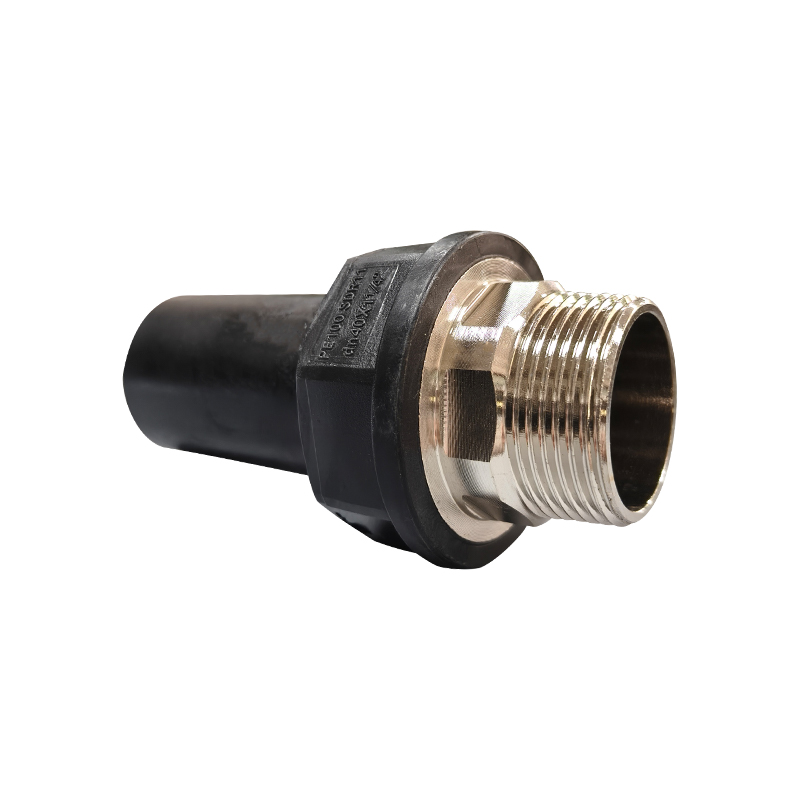
Threaded transition fittings have a molded HDPE male or female thread on one side and a socket or fusion end on the other. They are used to connect HDPE pipe to steel valves, pumps, brass fittings, or existing threaded pipe systems.
Bolted split-sleeve coupling
A bolted split-sleeve coupling consists of two half-shells with a continuous gasket inside. The two halves are placed around the pipe ends and bolted together. This design is popular for large diameters and for repair clamps where the pipe cannot be slid into a one-piece coupling.
| Type | Connection action | Pressure class | Disassembly | Typical use |
|---|---|---|---|---|
| Compression sleeve coupling | Compress gasket with nut or bolts | PN10 to PN25 depending on design | Yes, in most designs | Repairs, tie-ins, above-ground pipe |
| Flanged connection | Bolt flange to matching flange | Matches pipe pressure class | Yes | Valves, pumps, equipment connections |
| Threaded transition fitting | Screw onto male or female thread | PN10 to PN16 typically | Yes, if thread sealant allows | Transition to metal or threaded equipment |
| Bolted split-sleeve coupling | Bolt two half-shells together | PN10 to PN25 | Yes | Large-diameter repair and confined spaces |
When selecting a type, start with the connection you actually need. If you are joining two plain HDPE pipe ends, a compression sleeve coupling is the most direct solution. If you are connecting to a pump flange, use a flange adapter. If you are connecting to a threaded metal component, use a threaded transition fitting.
Mechanical Coupling vs Fusion Welding: Key Differences
Fusion welding creates a permanent, monolithic joint by melting HDPE molecules together. A mechanical coupling creates a separable joint by pressing an elastomer against the pipe. Fusion is generally the first choice for new buried water and gas pipelines. Mechanical coupling is usually the more practical choice for repairs, emergency work, transitions, and installations where fusion equipment cannot be brought to the site.
Relative comparison for a typical field repair
Installation time
Mechanical coupling
Fusion installation time
Butt fusion / electrofusion
Field equipment weight
Mechanical coupling
Fusion equipment weight
Butt fusion machine and generator
Chart values are indicative and vary with pipe diameter, coupling design, and crew experience.
| Factor | Mechanical coupling | Heat fusion |
|---|---|---|
| Joint structure | Sealed mechanical connection with elastomer | Monolithic fusion weld of the pipe material |
| Installation time | Minutes to about an hour | Often 1 to 3 hours including cooling time |
| Required equipment | Pipe cutter, chamfer tool, wrenches, torque wrench | Butt fusion or electrofusion machine, generator, hydraulic unit |
| Wet or dirty site | More tolerant | Requires dry surfaces and controlled conditions |
| Disassembly | Possible with bolted designs | Not possible without cutting the pipe |
| Pressure capacity | Can match pipe PN rating if properly selected | Normally matches the full pipe pressure rating |
| Long-term behaviour | Gasket ageing and torque relaxation must be checked | Weld integrity is usually comparable to the pipe wall |
| Best fit | Repairs, temporary lines, transitions, access-limited sites | New permanent pipelines, gas lines, high-pressure systems |
For pipelines where fusion is feasible, it remains the most common joining method because it does not rely on an elastomer that can age. But fusion has real limitations: it needs power, clean or dry surfaces, trained operators, and enough space around the pipe. Mechanical couplings are deliberately designed for the situations where those conditions do not exist.
It is worth comparing the fusion methods themselves before choosing a full welding program. Our socket fusion versus butt fusion comparison explains where each process fits in a real pipeline project.
Where Mechanical Couplings Are the Preferred Choice
Mechanical couplings are not a replacement for all fusion welding. They are a preferred solution in a specific set of conditions: emergency repair, temporary bypass, mixed-material transition, confined-space installation, and connections to flanged equipment.
Emergency leak repair
A damaged HDPE section can be cut out and replaced using two mechanical couplings or a single repair coupling. The line can be back in service the same day.
Temporary bypass lines
Mechanical couplings allow a crew to install a temporary above-ground HDPE bypass while the buried main is repaired. The bypass can be removed later without cutting permanent pipe.
Transition to steel, PVC, or brass
Flange adapters and threaded transition fittings connect HDPE pipe to metal flanges, valves, and pumps without changing the entire system to HDPE.
Confined-space installation
A butt fusion machine needs length to grip both pipe ends. Mechanical couplings need less working space, so they are useful in valve pits, shafts, and tight building service rooms.
Saturated or underwater trenches
Fusion welding can be difficult when the pipe surface is wet or the trench keeps filling with water. A mechanical coupling can be assembled in those conditions if the gasket and housing are clean.
Mechanical couplings are common in municipal water supply, irrigation networks, mining slurry lines, industrial process piping, and marine applications. Building services also use mechanical joint types for HDPE drainage and siphon systems, especially where access for fusion welding is limited.
Pressure Ratings and Engineering Limits
Correctly selected mechanical couplings can handle the same nominal pressure class as the HDPE pipe itself. The practical limit is not only the seal, but also the resistance of the coupling to axial pull-out and temperature-related pipe movement.
| SDR | Pressure class | Common application |
|---|---|---|
| SDR 7.4 | PN25 | High-pressure industrial and water supply systems |
| SDR 9 | PN20 | High-pressure water and mining lines |
| SDR 11 | PN16 | Municipal water supply and irrigation |
| SDR 13.6 | PN12.5 | Medium-pressure water and industrial lines |
| SDR 17 | PN10 | Gravity systems, low-pressure water, and drainage |
The pipe SDR influences the outer diameter for a given nominal size, but more importantly it affects wall stiffness and the amount of radial compression the pipe can accept. A coupling designed for SDR 11 may also fit SDR 17 because the outer diameter is the same, but the gasket compression range and grip behavior are different. Always check the wall thickness range stated on the coupling label.
Pressure rating alone does not tell you whether the coupling is restrained. A non-restrained mechanical coupling can hold pressure in a static test yet fail when the pipe contracts due to cold weather or when soil movement pulls the joint apart. For buried pipelines, use a restrained coupling, an external anchoring system, or a thrust block.
Temperature also changes the long-term behavior of HDPE. At higher operating temperatures, the allowed working pressure decreases. When the system will operate above 20°C, select a thicker pipe wall and confirm that the gasket material in the mechanical coupling is rated for the fluid temperature. EPDM gaskets are common for water, but incompatible with hydrocarbons and some chemicals.
Threaded and Compression Products for Mechanical Connections
From our own production program, the two most relevant mechanical connection families are HDPE threaded fittings and PE/PP compression fittings. These are complementary: threaded fittings are used when the connection point has a BSP or NPT thread, while compression fittings are used when the joint needs a simple socket connection without heat.
As a pipe and fitting manufacturer, we machine or mold the threads directly into the PE100 body. This avoids mixing a separate metal insert into the wetted section, keeps the fitting lighter, and gives the installer a clean thread geometry for sealing. Compression fittings in the PE/PP range work with a similar mechanical principle: the insert is placed into the pipe end, a cap is tightened, and an O-ring or gasket compresses onto the pipe wall.
| Feature | HDPE thread fitting series | PE/PP compression fitting series |
|---|---|---|
| Connection type | Male or female BSP/NPT thread | Compression socket with O-ring seal |
| Heat required | No heat for the threaded connection | No heat |
| Main applications | Valves, pumps, metal pipe transitions | Irrigation, plumbing, low-to-medium pressure lines |
| Repeated assembly | Possible, but thread sealant should be renewed | Yes, easier to open and reconnect |
| Typical materials | HDPE PE100 body | PE or PP body with elastomeric O-ring |
Both product families solve real installation problems. A contractor connecting a polyethylene line to a stainless steel pump can use a male thread adapter on the HDPE side and a standard threaded flange or union on the equipment side. A maintenance team repairing a low-pressure water line without fusion equipment can use a PE/PP compression socket fitting and finish the job in minutes.
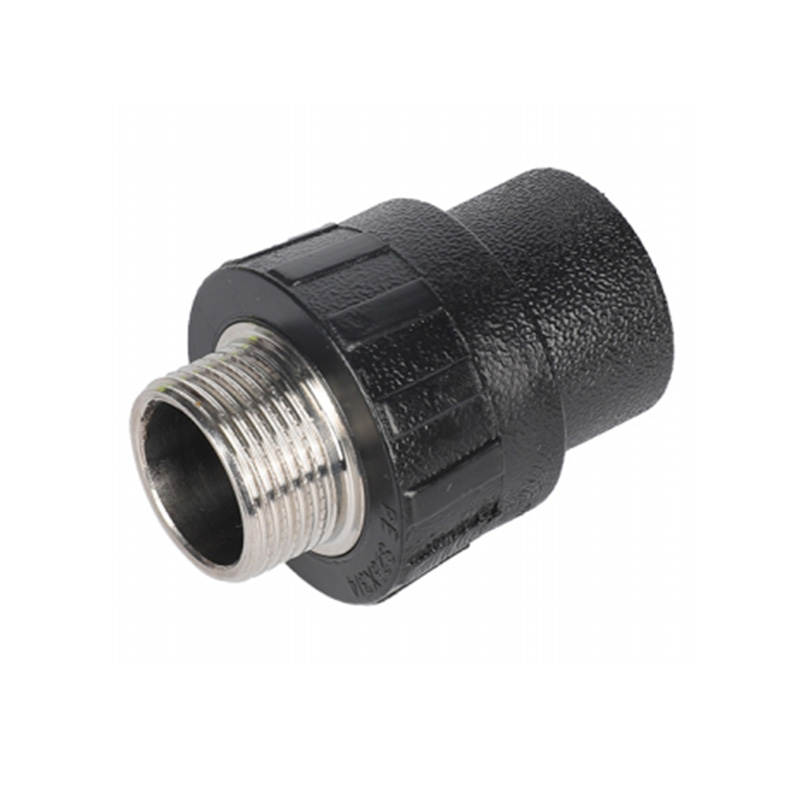 HDPE Male Thread Adapter for Corrosion-Resistant Pipe ConnectionsThis adapter connects HDPE pipes to threaded metal equipment, offering chemical resistance and leak-proof sealing. Its lightweight design simplifies installation, making it ideal for mixed-material systems.View Product →
 PE/PP Compression Socket for Tool-Free Pipe JoiningThis socket joins same-diameter pipes without welding or heat fusion, using a compression mechanism for a secure, leak-proof fit. Suitable for water, gas, and irrigation applications where quick repairs matter.View Product →
Step-by-Step Installation Procedure for Mechanical Couplings
The fastest mechanical coupling installation still fails if the pipe preparation is poor. Because a mechanical seal depends on compression against the outside surface, the pipe end must be cut cleanly, chamfered, clean, and inserted to the correct depth.
- Confirm the pipe outer diameter, wall thickness, and SDR before selecting the coupling. Do not assume the nominal size is enough.
- Cut the HDPE pipe square using a pipe cutter, handsaw with a miter box, or wheel cutter. Avoid a rough spiral cut that will damage the gasket.
- Chamfer or deburr the outside edge of the pipe end. A chamfer of 15 to 30 degrees helps the pipe slide into the gasket without rolling it out of position.
- Clean the exterior surface of the pipe. Remove mud, grease, loose PE chips, and surface moisture from the area that will contact the gasket.
- Check the insertion depth marking on the coupling body. If there is no mark, place the two pipe ends side by side and measure the depth before assembly.
- Disassemble the coupling enough to slide the housing, compression rings, and gaskets onto the pipe in the correct order.
- Insert the first pipe end to the full depth, then insert the second pipe end until both are correctly positioned inside the sleeve.
- Hand-tighten the bolts or nuts evenly, then use a torque wrench to tighten them in a crossing pattern. Never tighten one side completely before the other side.
- Check that the pipe remains in the same alignment and that the gap between the pipe ends is even. A one-sided gap can reduce sealing performance.
- Pressure-test the joint slowly, following the working pressure of the system. Watch the coupling for leaks during the initial pressure hold and again after thermal stabilization.
If the coupling uses a torque specification, follow it. Over-tightening can crush the PE pipe wall or extrude the gasket into an incorrect position. Under-tightening leaves the seal unprepared for service pressure. A torque wrench is a small investment compared with the cost of digging up a buried joint.
Common Mistakes and Procurement Risks
Most mechanical coupling failures on HDPE pipe are not caused by a bad coupling design. They come from wrong sizing, poor surface preparation, uneven tightening, or using a non-restrained coupling on a pipeline that needs axial restraint. These problems are avoidable when the installer treats a mechanical joint as a precision assembly rather than a clamp.
| Mistake | Result | Prevention |
|---|---|---|
| Selecting by nominal size without checking outer diameter | Coupling is too loose or too tight | Measure OD, wall thickness, and pipe SDR before ordering |
| Missing the outside chamfer | Gasket is pushed out while inserting the pipe | Use a chamfer tool or file to create a smooth entry edge |
| Uneven bolt tightening | Gasket compression is higher on one side, causing leaks | Tighten in a crossing sequence with a torque wrench |
| Using a non-restrained coupling in a buried line | Joint separates under thermal contraction or soil movement | Use a restrained coupling or add thrust anchors |
| Installing on a scratched or contaminated pipe surface | Leak path along the pipe wall | Clean and inspect the full seal zone before assembly |
| Ignoring pressure derating at higher temperatures | Long-term creep causes loss of gasket compression | Confirm operating temperature and select a higher pressure class |
When purchasing mechanical couplings from a manufacturer, ask for the exact wall thickness range, torque specification, gasket compound, and pressure test certificate. A supplier that cannot answer those four questions is not giving you enough information for a safe installation.
Mechanical Coupling Selection Checklist for HDPE Pipe
A short checklist helps engineering teams compare offers without relying on brand names or vague descriptions. The same questions should be answered for every mechanical coupling before it is approved for a project.
- Pipe OD and wall thickness: Match the coupling to the exact PE pipe dimension, not just DN.
- Pressure class: Confirm that the coupling pressure rating equals or exceeds the required working pressure at the actual operating temperature.
- End-load resistance: Determine whether the coupling is restrained and whether thrust blocking is still necessary.
- Gasket compatibility: Verify that the elastomer is compatible with the fluid, temperature, and chemical exposure.
- Space for assembly: Check that the crew can reach the bolts or nuts and use a torque wrench around the installed pipe.
- Inspection and testing: Confirm the coupling marking, test records, and installation literature are supplied with each batch.
Frequently Asked Questions
Is a mechanical coupling as strong as fusion welding?
Not in the same way. Fusion welding makes the joint material continuous with the pipe wall, while a mechanical coupling depends on a compressed elastomer and the grip of the housing. A correctly selected mechanical coupling can match the pipe pressure class, but the long-term behavior under cyclic loading and axial pull-out must be evaluated separately.
Can a mechanical coupling on HDPE pipe be buried underground?
Yes, provided the coupling is made from corrosion-resistant materials, the pipe surface is clean, and the joint is installed inside a proper trench bed. For buried systems, use a restrained coupling or provide external anchoring so soil movement and thermal expansion cannot pull the joint apart.
Do I need special tools to install a mechanical coupling?
Most mechanical couplings need a pipe cutter or saw, a chamfer tool, cleaning rags, wrenches, and a torque wrench. Some large-diameter bolted couplings require a torque multiplier or hydraulic wrench, but the basic principle is the same.
Can I use a mechanical coupling for potable water HDPE pipe?
Yes, if the coupling materials meet the relevant potable water regulations. The seal and lubricant must be approved for drinking water contact. Confirm this with the manufacturer and request the applicable certificates for the project location.
How long does a mechanical coupling last on HDPE pipe?
Service life depends on the gasket material, operating temperature, pressure, and installation quality. EPDM gaskets are often rated for decades when kept within their design envelope. The HDPE pipe itself is commonly designed for more than 50 years, but the gasket should be inspected in critical systems.
Which is better for a transition to a metal pump: a thread fitting or a compression socket?
If the pump connection is threaded, use an HDPE thread fitting that matches the pump thread type. If the connection is a plain pipe end or a smooth stub, a compression socket can be a faster option. Both are mechanical joints, so the surrounding pipe must be supported to prevent vibration from loosening the connection.
KEEP IN TOUCH

About Us
Zhejiang Fengfeng Pipe Industry Co., Ltd. uses efficient single screw injection molding machines for high productivity and low energy use.
Products link
Contact
-

+86-19858193396
+86-13735359894 -

+86-0574-63555288
-

-

No. 21, Market Road, Diankou Town, Zhuji City, Shaoxing City, Zhejiang Province, China